


Page 65 - IFSO-History-Book-Digital-File
P. 65
The Middle East and North African Chapter (IFSO-MENAC)
                                                                               Khaled Gawdat
                                                                      Growth, Leadership, and Regional Impact of the IFSO MENA Chapter
                                                                      The Middle East and North African (MENA) region is a geographic bridge between Africa and Asia
                                                                      that, while not a single geographic entity, shares a unified cultural identity through similar languages,
                                                                      religions, and traditions. The International Federation for the Surgery of Obesity Middle East and
                                                                      North  African  Chapter (IFSO-MENAC) is the youngest chapter  in IFSO, founded in 2017, and
                                                                      currently includes 12 member countries.  Although geographically part of the broader region, Israel,
                                                                      South Africa, and Turkey remain members of the European Chapter.
                                                                      Origins and Precursor Societies (1999-2016)
                                                                      The foundational idea for a regional chapter began in 1999 when the Egyptian Society for Bariatric
                                                                      Surgery (ESBS), led by metabolic bariatric surgery (MBS) pioneer Professor Khaled Gawdat, and the
                                                                      Kuwaiti Society for Bariatric Surgery, led by then-Minister of Health Dr. Mohammad AlJarallah, joined
                                                                      IFSO as national societies. Because many countries in the region lacked surgery societies beyond
                                                                      the scope of general surgery, they were unable to join IFSO directly. To resolve this, the Egyptian and
                                                                      Kuwaiti societies applied to create a Pan Arab society affiliated with IFSO, ensuring that practitioners
                                                                      of MBS across the entire region could unite under one umbrella.
                                                                      The IFSO Executive Board and General Council approved these applications. Over the following
                                                                      years, as IFSO expanded globally, other nations in the region joined, including the United Arab
                                                                      Emirates (2008), Saudi Arabia (2009), Lebanon (2012), Jordan (2015), and Iraq (2019). Initially, these
                                                                      countries joined the IFSO-APC or IFSO-EC until a dedicated regional framework could be
                                                                      established.
                                                                      Working toward united representation, two distinct precursor societies were formed: (1) the Gulf
                                                                      Obesity Surgery Society (GOSS): Formed during a 2012 meeting in Dubai, GOSS included the Gulf
                                                                      countries (Saudi Arabia, Kuwait, United Arab Emirates, Qatar, Bahrain, and Oman), with Mohammad
                                                                      AlJarallah serving as its first president. Their inaugural conference was held in Kuwait in 2013. And,
                                                                      (2) the Pan Arab Society for Metabolic and Bariatric Surgery (PASMBS): Formed in 2015 for the
                                                                      remaining MENA countries (Egypt, Lebanon, Jordan, Iraq, and Libya), with Khaled Gawdat serving as
                                                                      its first president. PASMBS held its first conference in Cairo in 2016.
                                                                      Establishment and Early Leadership (2016-2018)
                                                                      In  a  landmark  meeting  in  November,  2016,  in  Cairo,  held  during  the  ESBS  meeting,  GOSS  and
                                                                      PASMBS agreed to join forces to apply for the IFSO-MENA Chapter. The IFSO General Council
                                                                      formally approved the application in 2017. Initially formed by six countries—Kuwait, the United Arab
                                                                      Emirates, and Saudi Arabia from GOSS; and Egypt, Lebanon, and Jordan from PASMBS—the chapter
                                                                      later expanded to include Libya, Iraq, Tunisia, Bahrain, Oman, and Pakistan. Formal elections to
                                                                      appoint the Executive Board and Officers of the MENAC were held in Dubai in December 2017.
                                                                      From April 12-13, 2019, the 1st IFSO-MENAC meeting was held in Kuwait City, Kuwait (Salman Al
                                                                      Sabah, President); October 30-31, 2020, the 2nd meeting was convened as a virtual congress due to
                                                                      COVID-19 (Waleed Bukhari, President); the 3rd meeting, May 11-14, 2022, was held in Al Khobar,
                                                                      Saudi  Arabia (Prof. Mirza Gari, President); and the 4th, December 12-14, 2024, in Cairo, Egypt
                                                                      (Khaled Gawdat, President).
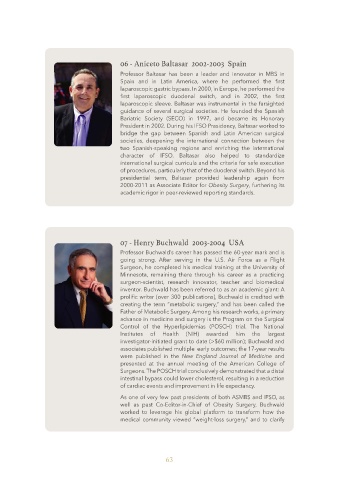
                                           06 - Aniceto Baltasar  2002-2003  Spain
                                           Professor Baltasar has been a leader and innovator in MBS in
                                           Spain  and  in  Latin  America,  where  he  performed  the  first
                                           laparoscopic gastric bypass. In 2000, in Europe, he performed the
                                           first  laparoscopic  duodenal  switch,  and  in  2002,  the  first
                                           laparoscopic sleeve. Baltasar was instrumental in the farsighted
                                           guidance of several surgical societies. He founded the Spanish
                                           Bariatric  Society (SECO) in 1997, and became its Honorary
                                           President in 2002. During his IFSO Presidency, Baltasar worked to
                                           bridge the gap between Spanish and Latin  American surgical
                                           societies, deepening the international connection  between the
                                           two Spanish-speaking regions and enriching the international
                                           character of IFSO. Baltasar also  helped to  standardize
                                           international surgical curricula and the criteria for safe execution
                                           of procedures, particularly that of the duodenal switch. Beyond his
                                           presidential term, Baltasar provided leadership again from
                                           2000-2011 as Associate Editor for Obesity Surgery, furthering its
                                           academic rigor in peer-reviewed reporting standards.
                                           07 - Henry Buchwald  2003-2004  USA
                                           Professor Buchwald’s career has passed the 60-year mark and is
                                           going strong.  After  serving in the  U.S.  Air Force as  a Flight
                                           Surgeon, he completed his medical training at the University of
                                           Minnesota, remaining there through his career as a practicing
                                           surgeon-scientist, research innovator, teacher and biomedical
                                           inventor. Buchwald has been referred to as an academic giant: A
                                           prolific writer (over 300 publications), Buchwald is credited with
                                           creating the term “metabolic surgery,” and has been called the
                                           Father of Metabolic Surgery. Among his research works, a primary
                                           advance in medicine and surgery is the Program on the Surgical
                                           Control of the Hyperlipidemias  (POSCH) trial.  The  National
                                           Institutes  of  Health  (NIH)  awarded   him   the  largest
                                           investigator-initiated grant to date (>$60 million); Buchwald and
                                           associates published multiple  early outcomes; the 17-year results
                                           were published in the  New England  Journal of Medicine and
                                           presented at the annual meeting of the  American College of
                                           Surgeons. The POSCH trial conclusively demonstrated that a distal
                                           intestinal bypass could lower cholesterol, resulting in a reduction
                                           of cardiac events and improvement in life expectancy.
                                           As one of very few past presidents of both ASMBS and IFSO, as
                                           well as  past  Co-Editor-in-Chief  of  Obesity Surgery,  Buchwald
                                           worked to leverage his global platform to transform how the
                                           medical  community  viewed  “weight-loss  surgery,”  and  to  clarify


                                                           63

