


Page 63 - IFSO-History-Book-Digital-File
P. 63
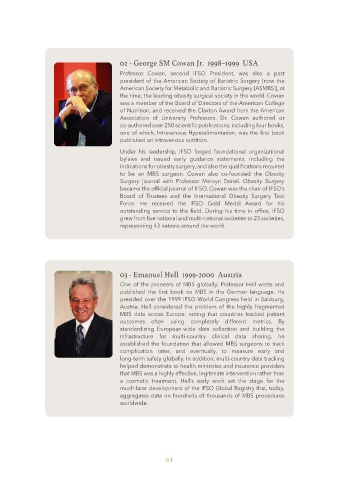
02 - George SM Cowan Jr.  1998–1999  USA

                                           Professor Cowan, second IFSO President, was also a past
                                           president of the American Society of Bariatric Surgery (now the
                                           American Society for Metabolic and Bariatric Surgery [ASMBS]), at
                                           the time, the leading obesity surgical society in the world. Cowan
                                           was a member of the Board of Directors of the American College
                                           of Nutrition, and received the Claxton Award from the American
                                           Association of University Professors. Dr. Cowan authored or
                                           co-authored over 250 scientific publications, including four books,
                                           one of which, Intravenous Hyperalimentation, was the first book
                                           published on intravenous nutrition.

                                           Under his leadership, IFSO forged foundational organizational
                                           bylaws  and issued  early guidance  statements,  including the
                                           indications for obesity surgery, and also the qualifications required
                                           to  be  an  MBS  surgeon.  Cowan also  co-founded  the  Obesity
                                           Surgery journal with Professor Mervyn Deitel.  Obesity Surgery
                                           became the official journal of IFSO. Cowan was the chair of IFSO’s
                                           Board of  Trustees and the International Obesity Surgery  Task
                                           Force.  He  received  the  IFSO  Gold  Medal  Award  for  his
                                           outstanding  service  to  the  field.  During  his  time  in  office,  IFSO
                                           grew from five national and multi-national societies to 23 societies,
                                           representing 43 nations around the world.


                                           03 - Emanuel Hell  1999-2000  Austria
                                           One of the pioneers of MBS globally, Professor Hell wrote and
                                           published  the  first  book  on  MBS  in  the  German  language.  He
                                           presided over the 1999 IFSO World Congress held in Salzburg,
                                           Austria. Hell considered the problem of the highly fragmented
                                           MBS data across Europe, noting that countries tracked patient
                                           outcomes often using completely different metrics. By
                                           standardizing European-wide data collection and building the
                                           infrastructure for multi-country clinical data sharing, he
                                           established the foundation that allowed MBS surgeons to track
                                           complication rates, and eventually, to measure early and
                                           long-term safety globally. In addition, multi-country data tracking
                                           helped demonstrate to health ministries and insurance providers
                                           that MBS was a highly effective, legitimate intervention rather than
                                           a cosmetic treatment. Hell’s early work set the stage for the
                                           much-later development of the IFSO Global Registry that, today,
                                           aggregates data on hundreds of thousands of MBS procedures
                                           worldwide.


                                                           61

