


Page 79 - IFSO-History-Book-Digital-File
P. 79
CHAPTER SEVEN


                 The Administrative Renaissance and
                 Era of Global Expansion (2010-2026)


                 Khaled Gawdat


                 The Structural Paradox Before 2010

                 In its first decade and a half, IFSO firmly cemented its reputation as a global scientific powerhouse.
                 Driven by the dedication of its visionary founders and pioneers, the federation published landmark
                 guidelines, established rigorous clinical standards, and facilitated an unparalleled exchange of
                 surgical knowledge.

                 However, a fundamental paradox hindered the society’s true potential: Despite its scientific strength,
                 IFSO operated with a suboptimal administrative structure. Relying on volunteer-led, decentralized
                 management meant that communication with national chapters was fragmented, revenue streams
                 were  difficult  to  track,  and  executing  large-scale  global  initiatives  proved  difficult.  Scientific
                 excellence without structured institutional governance was inadequate to meet the challenges of the
                 emerging field.


                 The 2010 Catalyst: A Vision for an Institution
                                             The critical pivot and supportive decision-making occurred in 2010
                                             during the IFSO presidency of Dr. Harry Frydenberg. Recognizing
                                             that  sustainable  global  influence  required  a  professional
                                             administrative backbone, Dr. Luigi Angrisani took a decisive step:
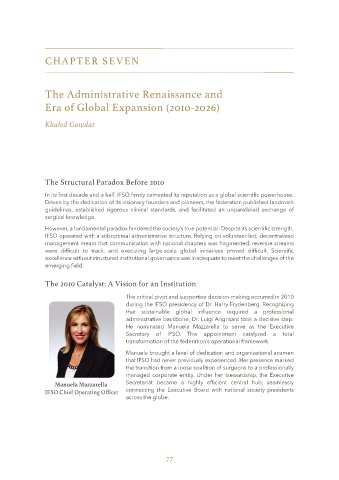
                                             He nominated Manuela Mazzarella to serve as the Executive
                                             Secretary  of  IFSO.  This appointment  catalyzed a  total
                                             transformation of the federation’s operational framework.

                                             Manuela brought a level of dedication and organizational acumen
                                             that IFSO had never previously experienced. Her presence marked
                                             the transition from a loose coalition of surgeons to a professionally
                                             managed corporate entity. Under her stewardship, the Executive
                    Manuela Mazzarella       Secretariat  became  a  highly  efficient  central  hub,  seamlessly
                 IFSO Chief Operating Officer  connecting the Executive Board with national society presidents
                                             across the globe.


                                                           77

