


Page 55 - IFSO-History-Book-Digital-File
P. 55
Scopinaro invited leading figures from IFSO, which had recently held its first congress in Prague
                 in1996 under the presidency of Professor Martin Fried. Angrisani focused on identifying and inviting
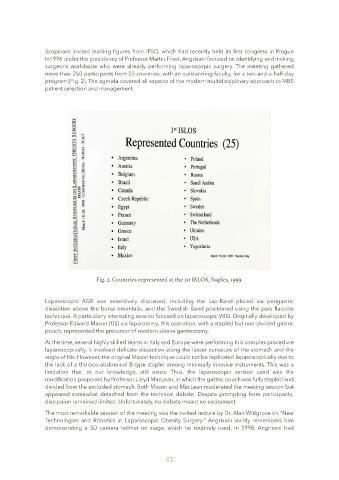
                 surgeons worldwide  who were  already performing  laparoscopic surgery. The meeting  gathered
                 more than 250 participants from 25 countries, with an outstanding faculty, for a two-and-a-half-day
                 program [Fig. 2]. The agenda covered all aspects of the modern multidisciplinary approach to MBS
                 patient selection and management.


                                   Fig. 2. Countries represented at the 1st ISLOS, Naples, 1999.


                 Laparoscopic  AGB was  extensively  discussed, including the Lap-Band placed  via perigastric
                 dissection above the bursa omentalis, and the Swedish Band positioned using the pars flaccida
                 technique. A particularly interesting session focused on laparoscopic VBG. Originally developed by
                 Professor Edward Mason (US) via laparotomy, this operation, with a stapled but non-divided gastric
                 pouch, represented the precursor of modern sleeve gastrectomy.
                 At the time, several highly skilled teams in Italy and Europe were performing this complex procedure
                 laparoscopically. It involved delicate dissection along the lesser curvature of the stomach and the
                 angle of His. However, the original Mason technique could not be replicated laparoscopically due to
                 the lack of a thoraco-abdominal B-type stapler among minimally invasive instruments. This was a
                 limitation that, to our knowledge, still exists.  Thus, the laparoscopic version used was the
                 modification proposed by Professor Lloyd MacLean, in which the gastric pouch was fully stapled and
                 divided from the excluded stomach. Both Mason and MacLean moderated the meeting session but
                 appeared somewhat detached from the technical debate. Despite prompting from participants,
                 discussion remained limited. Unfortunately, no debate meant no excitement.
                 The most remarkable session of the meeting was the invited lecture by Dr. Alan Wittgrove on “New
                 Technologies and Robotics in Laparoscopic Obesity Surgery.”  Angrisani vividly remembers him
                 demonstrating a 3D camera helmet on stage, which he routinely used. In 1998,  Angrisani had


                                                           53

